





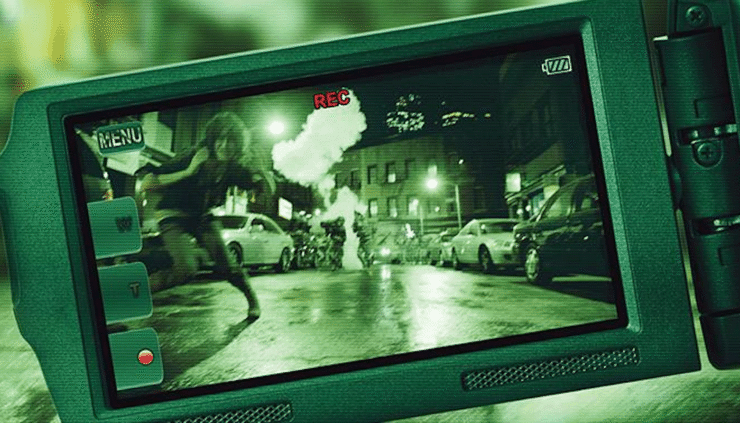
I recently went to see Backrooms (2026) and, for me, the scariest parts were the scenes that utilized found footage when exploring the liminal labyrinth. This style is perfectly suited to horror, feeling up-close and personal in a way that can easily be used to ratchet up feelings of dread and tension. Plenty of other horror films have used this technique to put the viewer right at the center of the scares—a few of the most popular being The Blair Witch Project (1999), Paranormal Activity (2007), and REC (2007).
But the found footage style can also be deployed just as effectively in other genres. With that in mind, here are five sci-fi and fantasy movies that make excellent use of the format.
Cloverfield (2008)
Admittedly, Cloverfield is a horror movie, but I’d definitely consider it science fiction too. Set in New York City, Hud (T.J. Miller) has been tasked with filming testimonials at the goodbye party for his best friend, Rob (Michael Stahl-David), who is about to move to Japan. But the celebration goes off the rails when an earthquake causes chaos across the city. Except it turns out that a natural disaster isn’t to blame—aliens are.
With a camera already in his hands, Hud keeps on filming as a small group from the party attempt to flee the city. As they venture through Manhattan, we get increasingly clearer glimpses of the aliens—which are both fascinating and horrifying—as well as witnessing the different human responses to them, from panicking crowds to attacking soldiers. At its core, Cloverfield is an exploration of the fear, confusion, and anxiety that people experience when faced with an unclear threat.
The shaky camera footage might not be to everyone’s taste, but I don’t think many people would have a steady hand when running away from a colossal extraterrestrial, so it feels pretty realistic given the situation.
Trollhunter (2010)
Trollhunter starts with a trio of university students in Norway deciding to investigate and document the illegal bear killings that have been taking place. Once they track down the suspected poacher, Hans (Otto Jespersen), they discover that he’s not actually hunting bears at all—he’s hunting trolls.
It turns out that the legendary creatures aren’t actually the stuff of myth, the government has just been keeping their existence a secret. Hans is an integral part of the cover-up, being tasked with killing any trolls that wander too close to populated areas. But he’s been underpaid and overworked for decades and he’s finally so fed up that he agrees to lift the lid on the secret, taking a starring role in an exposé about his job. The result is a film filled with dry, straight-faced humor, bitingly satiric commentary on government bureaucracy, wildly fun troll designs, and clever bits of lore.
Chronicle (2012)
The protagonist of Chronicle, Andrew Detmer (Dane DeHaan), feels like the antithesis of Peter Parker. Both are bullied teenage boys with difficult personal lives—Andrew is abused by his dad and his mom has cancer, while Spider-Man’s parents died when he was a child—but they have completely different reactions to gaining superpowers. In essence, they’re different sides of the same coin.
The movie begins with Andrew starting a video diary and he soon documents himself, his cousin Matt (Alex Russell), and popular kid Steve (Michael B. Jordan) exploring a cave that contains a glowing blue crystalline object. The three teens then gain telekinetic powers and while it seems like a dream come true at first, things eventually take a nightmarish turn.
Chronicle is at once a deconstruction of the superhero genre as a whole and an in-depth character study of a deeply damaged individual. And thanks to Andrew’s telekinetic powers, all of it is captured using more inventive camera angles than usually appear in found footage movies.
Europa Report (2013)
If you found yourself captivated by footage of the crew of the Artemis II mission back in April, then I recommend giving Europa Report a watch.
Six astronauts have been sent on a mission to explore Europa—one of Jupiter’s moons—in the hope of finding extraterrestrial life. The crew lost contact with Earth six months in, but the footage from the rest of their mission was sent in one final transmission months later. This premise is perfectly suited to the found footage format. There’s no question of “why are they still filming?” in high-pressure moments because documenting their discoveries is the whole point of the mission and their spacecraft and spacesuits are covered with cameras to facilitate that, without the astronauts even needing to personally frame a shot.
The majority of the movie is slow-paced and subtle, going for grounded realism rather than flashy sci-fi thrills. I could have done with the characters being slightly more fleshed out, but I still found myself drawn in by the tension that comes from them being alone in the vastness of space, having to troubleshoot problems without any help from scientists back on Earth.
LOLA (2022)
The vast majority of found footage movies are set in modern times—within the last 30 years or so—because that’s when the technology needed for their in-story creation became far more accessible. But LOLA takes the historical route—it’s set during World War II.
Although video cameras weren’t exactly common household objects during the ’40s, brooding inventor Thom (Emma Appleton) has crafted one for herself and her sister Mars (Stefanie Martini) to use. But a hand-held camera isn’t Thom’s greatest feat: creating a time machine is.
Named LOLA after their long-dead mother, the machine can receive radio and TV transmissions from the future. Thom and Mars decide to use the device to change the course of World War II—with disastrous consequences. Plot-wise, LOLA isn’t doing anything particularly revolutionary within the time travel sphere, but it’s still an intriguing story to follow and the unique combination of the format and time period gives the movie a distinctive charm.
Although horror usually dominates the found footage genre, there are surely more than just these five examples that lean into science fiction and/or fantasy instead—as always, feel free to leave your own favorite examples in the comments below!

my GOAT project almanac is always missing from these types of lists 😪
How many creatures in the original Cloverfield? I count just the one, plus its “fleas.”